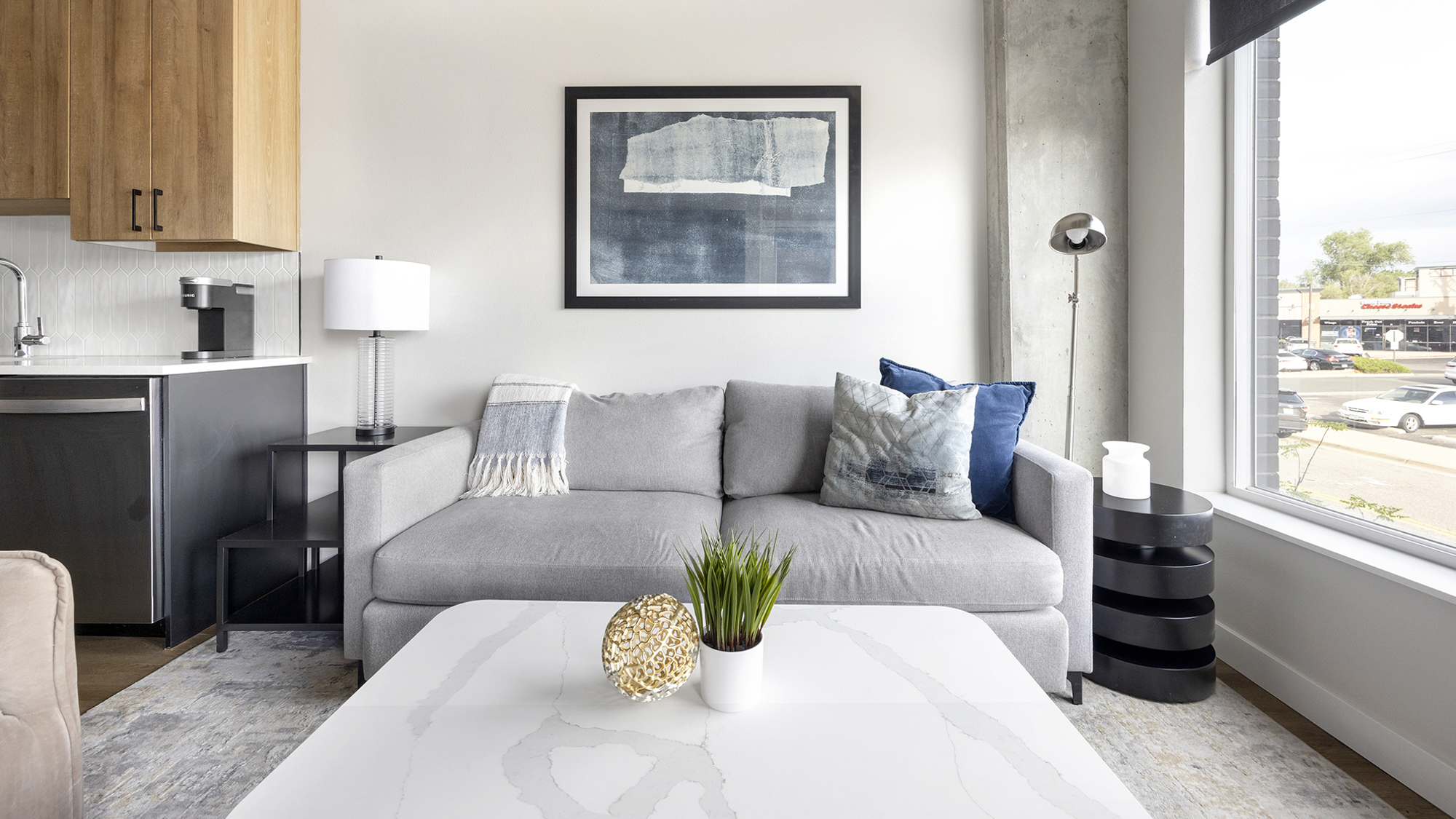
A studio apartment is one main room where you sleep, relax and usually cook, plus a separate bathroom. A one-bedroom apartment adds a bedroom with its own door, apart from the living area. That one wall is the real difference, and it shapes the size, the rent and how the space feels day to day. Here’s how the two layouts compare on size, cost and daily life, and what changes when you’re booking furnished apartments for a few months instead of signing a 12 month lease.
Studio vs one-bedroom at a glance
| Studio | One-bedroom | |
|---|---|---|
| Layout | One main room plus a bathroom | Separate bedroom, living room, kitchen and bathroom |
| Separate bedroom | No | Yes, with a door |
| Average size, U.S. apartments (RentCafe, 2025 data) | About 460 sq ft | About 735 sq ft |
| Median asking rent, 50 largest metros (Sept. 2026) | $1,422 | $1,568 |
| Kitchen | Full kitchen or a compact kitchenette, depending on the building | Usually a full kitchen |
| Best for | Solo renters, short stays, tighter budgets | Remote workers, couples, anyone who wants a door to close |
Sizes are from RentCafe’s 2026 analysis of Yardi Matrix data. Rents are from the Realtor.com September 2026 rental report. Both vary a lot by city.
What is a studio apartment?
A studio apartment is a single main room that works as your bedroom, living room and, in most cases, kitchen, with a separate bathroom. There’s no separate bedroom. In some parts of the country, a studio is called an efficiency.
Because everything shares one room, the layout is up to you. People zone a studio with a rug, a bookcase, a room divider or a sofa turned to face away from the bed. Some studios have a Murphy bed or a sleeping loft to free up floor space. Others have a separate kitchen area off the main room, while smaller units may only have a kitchenette with compact appliances.
You’ll also see a few studio variations in listings, such as alcove studios, with a nook for the bed, and convertible studios, with room to add a partition. Both are still studios: the sleeping area isn’t a closed bedroom. Our guide to types of apartments explains those layouts in more detail.
What is a one-bedroom apartment?
A one-bedroom apartment has a bedroom separated from the living space by walls and a door, plus a living room, a kitchen and a bathroom. Some include a dining nook or a bit of extra storage, such as a linen closet or pantry.
The bedroom door is the point. You can sleep while someone else watches TV, take a call without the bed in the background, or keep the living room guest-ready while the bedroom stays private.
How big is a studio apartment compared with a one-bedroom?
The average studio comes in at about 460 square feet and the average one-bedroom at about 735 square feet, according to RentCafe’s 2026 analysis of Yardi Matrix data. That’s roughly 275 extra square feet for the one-bedroom, and most of it goes to the bedroom.
A few things to keep in mind when you compare listings:
- Size varies by city. The same RentCafe report found the smallest new apartments in Seattle and Portland, Oregon, and the largest in Tallahassee and Gainesville, Florida.
- Studios are rarer than you might think. Studios made up only 5.2% of apartments completed in 2025, compared with 47.7% for one-bedrooms, per RentCafe. In many buildings, you’ll have far more one-bedroom options to choose from.
- Layout matters as much as square footage. A well-planned 500 sq ft studio can feel roomier than a chopped-up one-bedroom. Look at the floor plan, not just the number.
We see the same pattern in our own furnished apartments. In a November 2026 sample of about 1,600 Landing listings open for a January to April 2027 stay, the median studio was 473 square feet, the median one-bedroom was 744, and only about 6% of the sample were studios.
Is a studio cheaper than a one-bedroom?
Usually, yes, but the gap is smaller than many renters expect. In September 2026, the median asking rent across the 50 largest U.S. metros was $1,422 for a studio and $1,568 for a one-bedroom, a difference of about $146 a month, according to Realtor.com.
This is where the one-bedroom earns its keep. You pay about 10% more a month, and RentCafe’s sizes give you roughly 60% more floor space. The rent and size figures come from different surveys, so don’t read that as an exact price per square foot. As a rule of thumb, though, the jump in rent is small next to the jump in room. The studio still wins on the total monthly bill.
Other costs to weigh:
- Location: A studio in a sought-after neighborhood can cost as much as, or more than, a one-bedroom a few blocks away. Compare listings on the same street before deciding.
- Utilities: A smaller space generally costs less to heat and cool. If you’re budgeting for a lease, our guides to what utilities cover and how to save on utilities in your apartment can help.
- Furniture: A studio needs less of it. If you’d be buying everything new, check the average cost of furnishing an apartment before you sign. With a furnished apartment, that cost goes away.
Not sure what you can spend? Start with how much rent you can afford.
Studio vs one-bedroom: pros and cons
Studio
Pros
- Lower monthly rent in most markets
- Less to clean, furnish and heat or cool
- Everything within a few steps, which suits short stays and minimalists
Cons
- No door between your bed and the rest of your space
- Cooking smells and noise reach every corner
- Harder to share, host guests or keep work separate from rest
- Fewer studios on the market to choose from
One-bedroom
Pros
- A private bedroom you can close off
- Room for a desk, a dining table and a guest on the sofa
- Often more space per dollar
Cons
- Higher total rent and utilities
- More space to furnish if you’re bringing your own things
- Can be more than you need for a short or solo stay
Which is right for you?
Choose based on how you’ll actually use the space, not just the price. A few common situations:
- You work remotely. A one-bedroom lets you keep your workspace out of the bedroom and close the door at the end of the day. If you’re on video calls often, the separation is worth a lot.
- You’re sharing the space. Two people can live in a studio, but a door makes different schedules much easier. Check the listing’s occupancy rules either way. If you’re still deciding whether to share at all, see living alone vs with a roommate.
- You travel a lot or you’re in town for a project. If you’re out most of the day and mainly need a place to sleep, cook and reset, a studio keeps things simple.
- You like having people over. A one-bedroom gives guests a living room and gives you a private room to retreat to.
- You’re on a tight budget. A studio usually costs less each month. Just compare it against nearby one-bedrooms, since the gap can be small.
- It’s your first place. A studio is easier to set up and keep tidy. Our first apartment checklist covers the basics either way.
Choosing between studio and one-bedroom furnished apartments
With furnished apartments, the choice gets simpler, because you’re not buying, moving or fitting your own furniture into the space. On a furnished stay, the real question is how much room and privacy you want for the months you’re there.
We set up every Landing apartment before you arrive: furniture, a bed with linens, a full kitchen with cookware and dishes, a workspace, fast Wi-Fi and utilities shown in your price breakdown. Most units have a washer and dryer in the apartment. Before you confirm, you’ll see the full price, including rent, utilities, fees and taxes, and our support team is available 24/7. Our Landing Answers page covers the details.
A studio often makes sense for a solo apartment stay of a month or two. A one-bedroom tends to fit better for a longer assignment, for working remotely every day, or for two people. Each listing shows the unit type you’re booking, so you can compare a studio and a one-bedroom in the same area before you decide.
Find furnished apartments that fit how you live
A studio keeps life simple. A one-bedroom buys you a door. Landing has furnished apartments in 250+ U.S. cities, so browse furnished monthly rentals, see which layouts are open for your dates, and compare a studio and a one-bedroom side by side before you pick.
Frequently asked questions
Does a studio apartment have a bedroom?
No. A studio has no separate bedroom. You sleep in the same main room you live in, and usually cook in, with only the bathroom behind its own door.
What’s the difference between a studio and a one-bedroom apartment?
A one-bedroom has a bedroom separated from the living area by walls and a door. A studio combines sleeping and living space in one room. One-bedrooms are also larger on average, about 735 square feet versus about 460 square feet for a studio, per RentCafe.
How many square feet is a studio apartment?
The average studio is about 460 square feet, according to RentCafe’s 2026 analysis of Yardi Matrix data. Older and city-center studios can be smaller, and some are well over 500 square feet.
Is an alcove studio a one-bedroom?
No. An alcove studio has a nook for the bed, which adds some privacy, but the sleeping area isn’t a closed room with a door. It’s still a studio.
What is a junior one-bedroom?
Definitions vary by market. The term usually describes a unit that’s larger than a typical studio with a partly separated sleeping area, which may not be a fully enclosed bedroom. Check the floor plan to see whether there’s a real door and wall.
Can two people live in a studio apartment?
Often, yes, depending on the size of the space and the building’s occupancy rules. Many couples find a one-bedroom easier for different schedules or for working remotely.
Is it better to rent a studio or a one-bedroom?
A studio is usually better if you’re solo, out most of the day or keeping costs down. A one-bedroom is usually better if you work remotely, share the space or want a private room to close off.