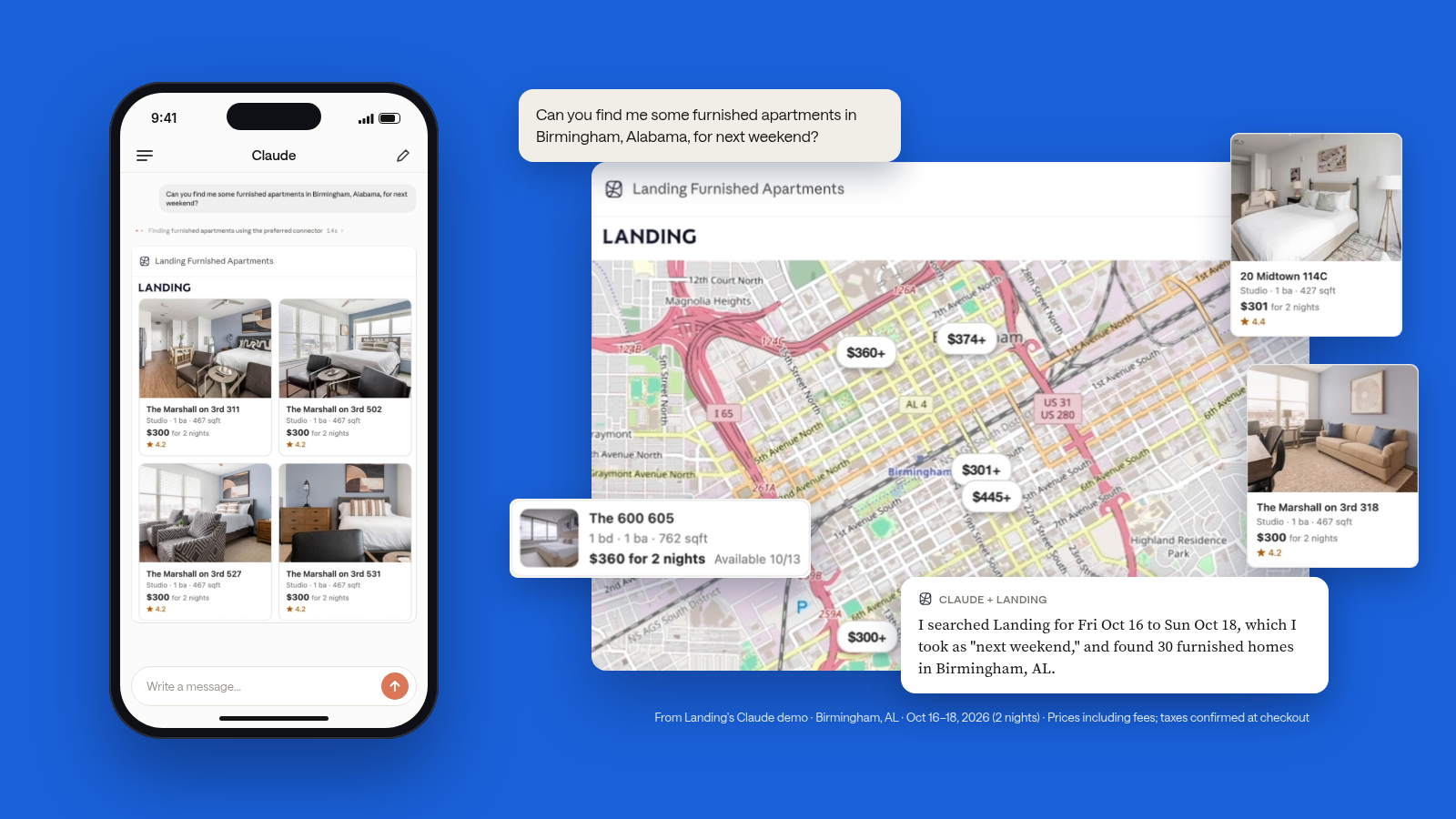
The easiest way to relocate for a job without a long-term commitment is to start in a furnished apartment on a flexible stay, then sign a lease once you know the city. Ask HR first what your relocation package covers, including temporary housing. At Landing, we have furnished apartments in 250+ U.S. cities. You can book a month, 3 months or 6 months when dates are available, with utilities included in the price breakdown and no traditional 12-month lease.
A job offer in a new city is exciting. Then the real work starts: a timeline, a budget and somewhere to live. This guide covers both halves: how to plan the move, and how to choose relocation housing for your first few months.
How to relocate for a job: job relocation tips at a glance
- Ask HR what your relocation package covers, including temporary housing, moving costs and timing.
- Set a budget for the move, the first months of housing and the costs of a new city.
- Build a realistic timeline working back from your start date.
- Start in temporary furnished housing so you can learn the city before you sign a lease.
- Pack with purpose: sort your belongings into sell, store or take.
- Research your new city and neighborhoods before you commit to a long-term home.
What is relocation housing and who uses it?
Relocation housing is furnished, temporary housing where you live while you move for work. It covers the gap between your start date and a permanent home, usually a few weeks to several months.
It’s used by:
- Employees moving for a new job or a transfer, booked by them or by their company.
- People on temporary assignments, such as consultants and project teams.
- Travel nurses and other professionals on fixed-length contracts.
- Interns working in a city away from home for a season.
- Companies housing new hires or teams through corporate housing.
What’s the best way to relocate without committing to a long-term lease?
The best way is to book a furnished apartment for your first one to six months, then look for a permanent home once you’re settled. A move-in ready Landing apartment lets you arrive with a suitcase and start work right away. If your search takes longer, request an extension in the Landing app. Approval depends on availability and your booking terms.

This gives you time to learn the neighborhoods, the commute and the cost of living before you commit to a year. You avoid signing a lease for an apartment you’ve only seen online.
The most common ways to do it:
- Ask whether your employer provides temporary housing. Some companies set you up in corporate housing or an extended-stay hotel. Others leave it to you.
- Book a furnished apartment on a flexible stay. Pick the length you need, and request an extension in the app if your search takes longer.
- Search for your long-term home from the new city. Tour in person, then sign a lease when you’re sure.
What to look for in relocation housing
Start with where you’ll live, then how the place works day to day.
Proximity
Live close to where you’ll spend your days. If you work on-site, look near the office. If your work moves around, as it does for visiting nurses, choose a central neighborhood near groceries and transit. In Washington, D.C., for example, compare a few neighborhoods by commute before you book.
Convenience
If you won’t have a car, check access to public transportation. If you drive, check parking. Look for the amenities that matter on a longer stay: a full kitchen, a dishwasher, a washer and dryer in the unit and someone to call when something breaks. A move-in ready apartment saves you buying furniture and setting up utilities.
Flexibility
Look for terms that fit an uncertain timeline. A 12-month lease is hard to leave if the role or the city changes. A furnished apartment on a flexible stay, or a month-to-month lease, lets you stay while you search, without a 12-month commitment. Check how extensions and notice work before you book, and whether utilities are included in the price.
Lifestyle
You’ll live and work here for weeks or months. Look for a quiet building, a real place to work, fast Wi-Fi and a bed you’ll sleep well in. If you’re bringing a pet, check the pet rules and fees before you book.
Temporary housing for job relocation
Once you accept a job relocation offer, you have five main housing options: furnished rental companies, corporate housing, extended-stay hotels, short-term rental platforms and listing sites. They differ in who manages the stay and how much setup is left to you.
| Option | Furnished? | Utilities | Who manages it | Best for |
|---|---|---|---|---|
| Furnished rental companies such as Landing | Yes, with a full kitchen; most have a washer and dryer in the unit | Included in the price breakdown | One company, with its own standards and 24/7 support | Relocating on your own or with company support, stays of a month or more |
| Corporate housing providers | Yes | Usually included | A provider, often under a contract with your employer | Employer-arranged moves and assignments |
| Extended-stay hotels | Hotel room, often with limited kitchen space | Included | The hotel | A few weeks, when a room is enough |
| Short-term rental platforms | Varies by listing | Varies by listing | Each individual host | Short stays where you’re happy to check each listing |
| Listing sites and individual landlords | Usually not | You set them up | Each landlord sets their own rules | Longer stays, if you can furnish it and sign a lease |
Furnished rental companies. These rent apartments that are already furnished and set up, on flexible terms. With Landing, you choose and book a move-in ready apartment online, with no application fees on direct bookings.
Corporate housing. Traditional providers are often built around employer contracts and longer procurement cycles. If your company is paying for the move, ask HR which provider it already uses and whether you can choose your own.
Extended-stay hotels. They work for a short bridge, but you usually get a smaller room and a hotel-style routine rather than an apartment.
Short-term rental platforms. These are marketplaces of individual hosts. Quality, rules, fees and support vary by listing, so read each one carefully.
Listing sites and individual landlords. Monthly rent is often lower here, especially on a 12-month lease in an apartment you furnish yourself. You’ll also face applications, deposits, furniture and utility setup, and many landlords want a 12-month lease. If you want flexible terms instead, see how a month-to-month lease works.
Housing for a 3 to 6 month corporate assignment
Book a furnished apartment for the length of the assignment, directly or through your company, and check how extensions work before you sign. Landing apartments can be booked for 3 months when those dates are available, and for 6 months or longer when availability allows. Longer stays may qualify for better monthly pricing through Stay Longer and Save.

For a 3 to 6 month assignment, look for:
- A full apartment, not a room. You’ll want a kitchen, laundry and a place to work.
- One price you can see upfront. Rent, utilities, Wi-Fi and fees in one breakdown make expense reports simpler.
- Extensions. Assignments often run long. With Landing you request an extension in the app; approval depends on availability and your booking terms.
- Support. Landing support is available 24/7 through the app, by phone or in person.
Travel nurse housing
Travel nurses need housing that matches the length of each contract. If you receive a housing stipend, you can often choose your own place and pick one that suits the assignment. Travel nurses on 13-week contracts can book a Landing apartment for that length when dates are available.
Intern housing
Interns working away from home need a furnished place for a fixed stretch, close to the office or campus. A furnished apartment means no bed or kitchen to buy for a few months, so you can focus on the work.
What corporate relocation housing works for employees on temporary assignments?
Companies usually choose between traditional corporate housing providers, furnished apartment companies that also serve companies, and extended-stay hotels. Landing corporate housing covers employee moves, temporary assignments, group stays and relocation programs across 250+ U.S. cities, and dedicated account support and volume pricing may be available.
- Traditional corporate housing providers are often built around employer-managed contracts and longer procurement cycles.
- Landing corporate housing works for both companies and individuals. The company can book, or the employee can search, book and move in directly. Landing corporate housing specialists can help with corporate moves and group stays.
- Extended-stay hotels work for a short bridge, but employees get a room rather than an apartment.
How do I find an apartment quickly when relocating for a new job?
If your start date is close, book housing before you arrive, so you can focus on the move and search for a permanent apartment in person. With Landing you search by city and dates, review the full price and book online. Landing guests never pay a security deposit or application fees when they book directly on hellolanding.com.
Trying to sign a long-term lease from another city means rushed tours, applications and deposits in a market you don’t know yet. A furnished stay removes that pressure. Book as early as you can, especially in high-demand cities. If you do want a lease straight away, have your ID, offer letter, proof of income and references ready, so you can apply as soon as you find the right place.
How do I secure a move-in ready apartment for a relocation without a long-term commitment?
Book a furnished apartment with utilities already running for the dates you know, and request an extension in the app if you need more time. Every Landing apartment comes with furniture, a full kitchen, a workspace and fast Wi-Fi, with utilities included in the price breakdown. Most have a washer and dryer in the unit, and the listing shows the laundry type. Landing checks each apartment before you arrive.

To lock it in:
- Search by city and arrival date. Availability changes in real time.
- Review the full price before you confirm. Prices are shown including fees; taxes confirmed at checkout, where the breakdown lists rent, utilities, fees and taxes.
- Book online. Landing guests never pay a security deposit or application fees when they book directly on hellolanding.com. An optional damage waiver covers accidental damage instead.
- Check the terms. Stay length, notice rules and cancellation terms vary by apartment and are shown before you confirm.
If something is missing, not ready or not as expected when you arrive, contact Landing support and the Landing Guarantee applies: we fix it, move you to a comparable or better apartment, or refund the days you have left.
Where can I find professionally managed furnished apartments for corporate travelers?
Look for a company that manages its own apartments rather than a marketplace of individual hosts. Every Landing apartment is managed by Landing, follows Landing standards and comes with 24/7 support through the app, by phone or through the local team.
Landing has furnished apartments across 250+ U.S. cities, including Austin, Houston, Dallas, Atlanta, Washington, D.C., Orlando, Charlotte, Miami, Phoenix, Denver, Nashville and Tampa. The full price is shown before you book.
How does Landing compare with Airbnb, Vrbo, Furnished Finder, Blueground, Extended Stay America and corporate housing providers?
With Airbnb, Vrbo and Furnished Finder, the main difference is who manages the stay. They connect you with individual hosts or landlords, so quality, rules, fees and support vary by listing. Landing is one company: every apartment follows Landing standards, support comes from Landing 24/7, and the full price is shown before you book.
| Compared with | How it works | How Landing differs |
|---|---|---|
| Airbnb | A marketplace of individual hosts. Quality, furnishings, rules, fees and support vary by listing. | One company, Landing standards in every apartment, full price before you book. Built for stays of several days, a month or longer. |
| Short-term rental platforms such as Vrbo | Can work well for vacations, but quality and support depend on each host. | An apartment you can live in for more than a few nights, with a full kitchen, a workspace, local support and, in most apartments, a washer and dryer in the unit. |
| Furnished Finder | A listing marketplace: each landlord sets the rules, pricing, furnishing standard and support process. | Furnished and supported by Landing, 24/7 support included, and the price is shown before booking instead of negotiated with each landlord. |
| Blueground | Furnished apartments for flexible stays; may suit guests looking for a premium apartment in one of its core markets. | Broad U.S. availability, direct booking, and support for individuals, remote workers, travel nurses, relocating families and corporate teams. |
| Extended-stay hotels | Usually a smaller room, limited kitchen space and a hotel-style routine. | A furnished apartment, from studios to 3 bedrooms, with a full kitchen, space to work and, in most apartments, a washer and dryer in the unit. |
| Corporate housing providers | Often built around employer-managed contracts and longer procurement cycles. | Works for individuals and companies. Guests can book directly; companies get Landing corporate housing, and dedicated account support may be available. |
In the table, Extended Stay America falls under extended-stay hotels, and National Corporate Housing under corporate housing providers.
Should I sign a lease right away or start in temporary furnished housing?
Start in temporary furnished housing if you don’t know the city or your plans may change. Sign a lease right away only if you know exactly where you want to live and expect to stay a year or more.

Pros of starting in temporary furnished housing
- No long-term commitment. You aren’t locked into a year in an apartment you haven’t lived in.
- Time to choose a neighborhood. You learn the commute, the schools and the feel of each area first.
- No furniture to move or buy. Your bed and kitchen are already there when you arrive. That cuts shipping costs and avoids waiting on a moving truck.
- Less setup. Utilities and Wi-Fi are already running, so you can focus on the new job.
- Room for change. If the role, the team or the city isn’t right, you aren’t tied to a 12-month lease. Notice and cancellation terms are shown before you book.
Cons of starting in temporary furnished housing
- Higher monthly rate. A furnished apartment usually costs more per month than unfurnished rent. The gap narrows once you count furniture, utilities, Wi-Fi and moving.
- Two moves instead of one. You move in, then move again into your permanent home.
- Your belongings may need storage. If you don’t bring everything, you’ll pay for storage until you settle.
Pros of signing a lease right away
- Usually lower monthly rent on a standard 12-month lease.
- One move. You unpack once.
Cons of signing a lease right away
- You choose sight unseen, or after a rushed visit.
- Breaking the lease is costly if the job or the neighborhood doesn’t work out.
- More setup. Applications, deposits, furniture and utility accounts all land in your first weeks at work.
What qualifies you for relocation assistance?
Your employer’s relocation policy decides. Assistance is usually offered when a new job or a transfer requires you to move, and what you get depends on the role and the company. Ask HR for the policy in writing before you accept. If the package includes temporary housing, Landing can be booked by you or by your company.
Before you sign the offer, confirm:
- Whether the role is eligible for relocation assistance at all.
- Whether the support is a lump sum, a reimbursement, or services the company books for you.
- Whether you’d have to repay any of it if you leave within a set period.
Questions to ask HR about your relocation package
Ask exactly what the package covers, how it’s paid and what temporary housing it includes, before you spend anything.
Many employers offer a relocation package for moving expenses. The amount depends on the role, the reason for the move and the company’s policy. Some companies pay costs upfront, and others reimburse you afterward. Clarify the terms before you accept.
Questions to ask HR or your hiring manager:
- What does the relocation package cover, and is there a cap?
- Are costs paid upfront, or reimbursed after I submit receipts?
- Does the package include temporary housing, and for how long?
- Does the company use a corporate housing provider, or can I book my own?
- Does it cover movers, shipping, storage or a rental truck?
- Does it cover a house-hunting trip to the new city?
- What start date is expected, and is there flexibility?
Keep accurate records of all relocation spending, including receipts, in a separate physical or digital file.
Budgeting for a job relocation
List every moving cost, subtract what your employer covers, and budget for the rest, including the cost of living in your new city.
Factor in moving supplies, shipping costs, storage units, professional movers or a rental truck, and travel for yourself.
Also factor in the cost of living where you’re going. A furnished rental and moving expenses in Los Angeles, for instance, may cost more than a furnished apartment in Birmingham, Alabama.
A realistic relocation timeline
Plan in three stages: before you accept, before you move, and your first weeks in the new city. Agree your start date with your manager with all three in mind.
A job relocation may come with a short timeline or a set start date. Agree it with your hiring manager, and include the time you need to move, unpack and settle in. If you have kids or pets, add time for school introductions and pet care. Consider timing the move around scheduled breaks or weekends to limit time away from your routine.
Before you accept the offer
- Confirm the relocation package and what it covers.
- Agree a start date that leaves time to move and settle.
- Research the cost of living in the new city.
Before you move
- Book temporary housing for your first months, and check how extensions work.
- Get quotes from moving companies or rental trucks, depending on how you’ll move your items.
- Buy packing materials.
- Separate belongings into three piles: sell, store or take.
- Book a storage unit if you need one.
- Schedule utility cancellation and mail forwarding with the post office.
- Update your online accounts with your new address.
- Track expenses on your budget sheet.
- Keep important documents in a safe place during the move.
- Ask colleagues or friends who have relocated for a job to recommend movers.
- Contact nonprofit organizations to pick up larger items you plan to donate.
Your first weeks in the new city
- Learn the commute from your temporary home to the office.
- Explore neighborhoods you might live in long term.
- Tour apartments in person before you sign a lease.
- Extend your temporary stay if your search runs long.
If you’re working during the move, block time on your calendar for relocation tasks so they don’t collide with meetings and deadlines.
Packing for a job relocation
Pack only what you’ll need in the new city, label every box, and keep essentials with you.
Decide what goes with you and what you’ll donate, store, sell or throw away. It takes time now and saves money later. Use the move to clear the clutter. Once you start packing, label each box by room and contents.
Keep a bag or box that travels with you rather than on a moving truck. Include your laptop, chargers, identification, important paperwork and anything you’ll need in the first few days. If you’re storing part of your belongings, keep an online inventory of what’s packed. That saves trips to search for misplaced items.
If you’re moving into a furnished apartment first, you can leave furniture and most kitchen items in storage until you find your permanent home.
Getting to know your new city before you move
Research the neighborhood, the commute and local groups before you arrive, and ask your hiring manager what resources they recommend.

Explore things to do and places to eat nearby. Use online groups on Facebook or Meetup to connect with people socially or for work. Ask your hiring manager or new team for local recommendations. A few questions to consider:
- What is your new city known for?
- Will you need to learn a public transportation system?
- How does the weather differ from where you live now?
- Are there neighborhood community groups you can join to settle in faster?
Once you’ve arrived, plan something fun in the first few days. Pick a part of the city to explore, or order in and rest.
Relocating for work with Landing
We have furnished apartments for job relocations and temporary assignments in 250+ U.S. cities, without a traditional 12-month lease. Every apartment is managed by Landing, so you know what you’re getting in every city.
- For you or your company. You can search, book and move in directly. Companies can use Landing corporate housing for employee moves, temporary assignments, group stays and relocation programs. Dedicated account support may be available.
- 3 month and 6 month stays. Book 3 months when those dates are available, a common fit for work assignments and relocations. Six months and longer are available when availability allows, and longer stays may qualify for better monthly pricing through Stay Longer and Save.
- Travel nurses. Nurses on 13-week contracts can book for that length when dates are available.
- Extensions in the app. If your search or assignment runs long, request an extension in the Landing app for iPhone or Android. Approval depends on availability and your booking terms.
- Move-in ready. Every Landing furnished apartment comes with furniture, a full kitchen, a workspace and fast Wi-Fi, with utilities included in the price breakdown. Most also have a washer and dryer in the unit; the listing shows which.
- Pet-friendly options. Many Landing apartments welcome pets. Pet rules and fees are shown on each apartment page before you book.
- Clear pricing. The full price breakdown is shown before you confirm. Landing guests never pay a security deposit or application fees when they book directly on hellolanding.com. An optional damage waiver covers accidental damage instead.
- Support around the clock. Local support is available 24/7 through the app, by phone or in person, and the Landing Guarantee applies if your apartment isn’t ready or as shown.

Book as early as you can, especially in high-demand cities. For corporate moves or group stays, Landing corporate housing specialists can help you book. Search by city and dates at hellolanding.com to see what’s available.
Frequently asked questions
Does my relocation package cover temporary housing?
It depends on your employer’s policy. Ask HR what the package covers, whether costs are paid upfront or reimbursed, and whether temporary housing is included.
How long should temporary housing last after a job relocation?
Long enough to find a permanent home without rushing. Book for the time you expect to need. If your search runs long, request an extension in the Landing app; approval depends on availability and your booking terms.
Is temporary furnished housing more expensive than signing a lease?
The monthly rate is usually higher than unfurnished rent. For a few months, it can cost less overall once you add furniture, utilities, Wi-Fi, moving and setup.
What is the difference between corporate housing and a furnished apartment?
Corporate housing is usually arranged by your employer through a provider under contract. A furnished apartment from a company such as Landing can be booked by you directly or by your company.
What are the best alternatives to hotels for extended business travel?
A furnished apartment. A hotel gives you a room; Landing gives you an apartment with a full kitchen and a workspace, and most have a washer and dryer in the unit. For many stays beyond a week, a Landing apartment costs less than a comparable hotel, and the full price is shown before you book.
Do I need a security deposit for a Landing apartment?
Landing guests never pay a security deposit or application fees when they book directly on hellolanding.com. An optional damage waiver fee is shown before you book.
Can I bring my pet to a Landing apartment during a relocation?
Many Landing apartments welcome pets. Pet rules, fees, breed restrictions and building requirements vary by property and are shown on the apartment page before you book.